Beginner's Guide to Tennis: Everything You Need to Know Before Your First Lesson
Beginner's Guide to Tennis: Everything You Need to Know Before Your First Lesson
Starting tennis can feel a little intimidating. You may wonder what equipment you need, whether you need to be athletic, how scoring works, or what your first lesson will actually look like. The good news is that beginners are not expected to arrive knowing any of this.
Tennis is a sport you can begin at almost any age. Children can build coordination and confidence through age-appropriate activities, while adults can enjoy an active, social way to exercise and learn a new skill.
At On The Rise Tennis Academy, beginners throughout San Diego County can learn through kids' group classes, adult group classes, private tennis lessons, and seasonal summer camps. Whether you're signing up your child or picking up a racket yourself, knowing a few basics beforehand can make that first trip to the court much easier.
Why Tennis Is a Great Sport for Beginners
Tennis combines movement, coordination, strategy, and social interaction. Unlike some activities that require a large team, tennis can be played with just two people, making it relatively easy to continue practicing once you've learned the fundamentals.
It can also provide meaningful physical benefits. A review of 24 studies on tennis and physical fitness found evidence linking regular tennis participation to aerobic fitness and several markers of cardiovascular and bone health.
For beginners, though, one of the biggest advantages is that there's always something new to improve. Early progress might mean making consistent contact with the ball. Later, it might mean sustaining a rally, serving accurately, or learning where to position yourself on the court.
You don't have to be "good at sports" before starting. That's what lessons are for.
What Do You Need for Your First Tennis Lesson?
You don't need a bag full of expensive equipment before taking beginner tennis lessons in San Diego. Start with the essentials.
A Tennis Racket
Choose a racket that feels comfortable to hold and fits your age and size. For children in particular, bigger isn't necessarily better.
Research involving children ages six to seven found that using smaller rackets during instruction led to greater improvements in forehand and backhand technique than using larger rackets over five weeks.
Age-appropriate equipment can make it easier for kids to control the racket and learn proper movements.
Comfortable Athletic Clothing
Wear clothing that allows you to move freely. Tennis involves reaching, rotating, bending, and changing direction, so comfort matters more than looking like a professional player.
Supportive Athletic Shoes
Tennis requires plenty of side-to-side movement. Wear supportive athletic shoes that allow you to move comfortably and securely around the court.
Water
Bring enough water, particularly when playing outdoors in San Diego. You'll probably spend more time moving than you expect during your first lesson.
The Tennis Court: A Quick Introduction
You don't need to memorize every line before your first class.
A tennis court is divided by a net. Players hit the ball over the net and try to land it inside the appropriate boundaries on the other side.
Singles uses the narrower court boundaries, while doubles uses the wider sidelines.
The service boxes are near the net. When serving, you stand behind the baseline and hit diagonally into the correct service box.
Your coach will explain the court as you use it, so there's no need to study a diagram beforehand.
The Basic Tennis Strokes You'll Learn
Beginner tennis classes generally focus on a handful of fundamental strokes.
Forehand
For many beginners, the forehand becomes one of the most natural strokes. You typically hit it on your dominant side after letting the ball bounce.
You'll learn how to prepare the racket, make contact with the ball, and follow through rather than simply swinging as hard as possible.
Backhand
A backhand is played on the opposite side of the body. Beginners may learn a one-handed or two-handed backhand, although the two-handed version is common for new players.
Serve
The serve starts each point. It involves hitting the ball from behind the baseline into the opposite service box.
Don't worry about developing a powerful serve immediately. Early lessons typically focus on a repeatable motion and getting the ball into the right area.
Volley
A volley is hit before the ball bounces, usually when you're closer to the net.
Volleys teach beginners racket control, quick reactions, and positioning.
How Tennis Scoring Works
Tennis scoring can sound strange at first, but it becomes straightforward once you've played a few games.
A standard game progresses through:
0 (love) → 15 → 30 → 40 → game
If both players reach 40, the score is called deuce. A player generally needs to win two consecutive points from deuce to win the game.
Games make up sets, and sets make up matches.
Your first few lessons will probably focus much more on hitting and movement than remembering every scoring rule, so don't feel like you need to memorize everything beforehand.
What Happens During Your First Tennis Lesson?
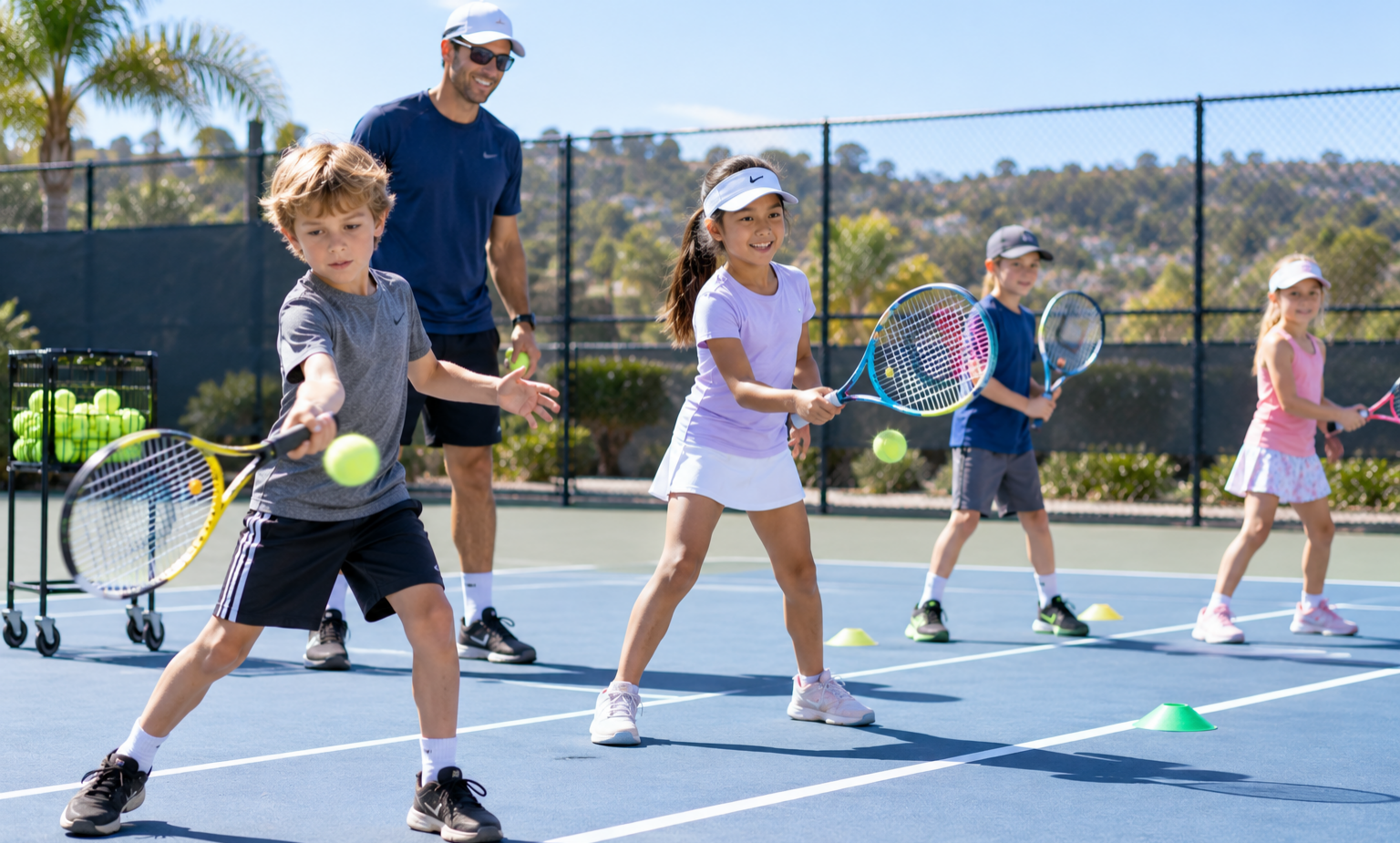
Every coach and class is different, but a beginner lesson usually starts with simple movement and racket activities before progressing into basic strokes.
You may practice bouncing a ball on your racket, tracking incoming balls, hitting from a stationary position, moving toward the ball, and attempting short rallies.
The goal isn't to play a perfect match on day one.
Instead, you're developing the building blocks that eventually make rallies and games possible.
This approach can be especially valuable for children. One study involving 81 junior tennis players ages six to 12 found that both technique-based and game-based tennis sessions improved measures of executive function compared with watching television. The game-based session produced particularly promising results for working memory and overall executive function.
Making beginner lessons interactive can therefore offer much more than stroke practice.
Group Classes or Private Tennis Lessons?
One common question among beginners is whether to start with group or private instruction.
Neither option is automatically better. They simply provide different experiences.
Group Tennis Classes
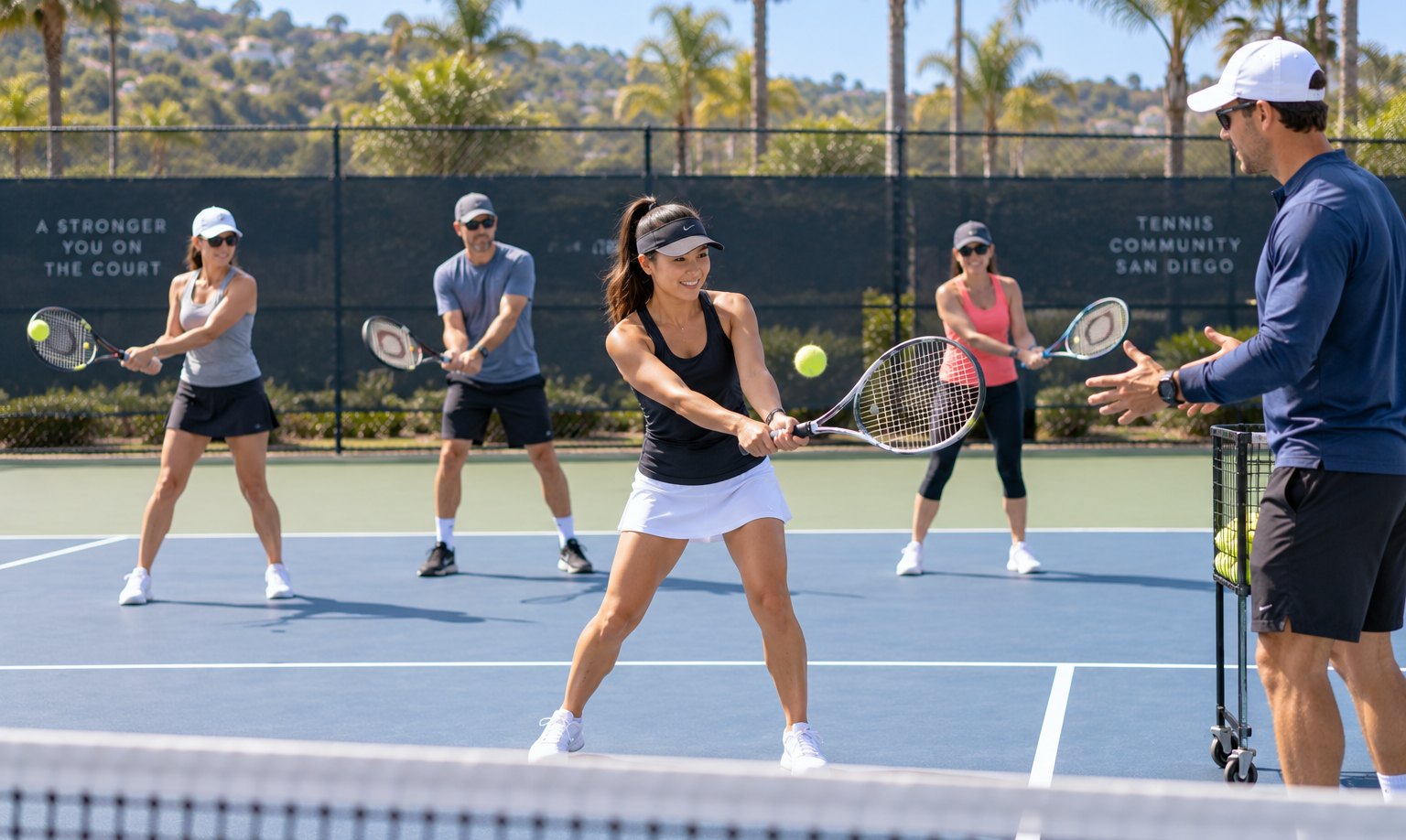
Group classes let beginners learn alongside players at a similar stage. They're particularly useful for developing rally skills, playing games, meeting other players, and getting comfortable on the court.
Kids can benefit from the social aspect, while adult group lessons can provide an enjoyable way to learn and meet other local players.
Private Tennis Lessons
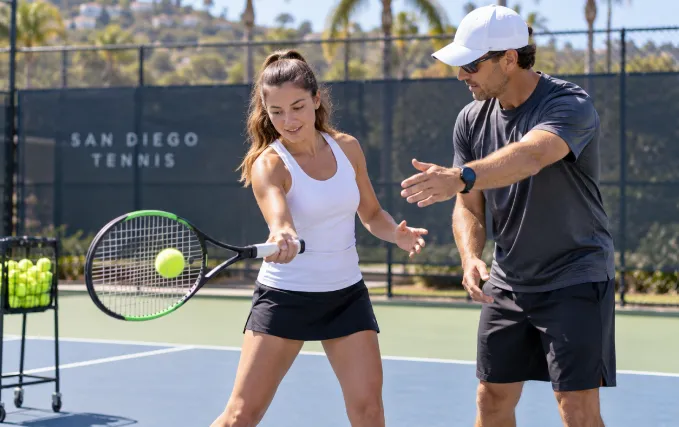
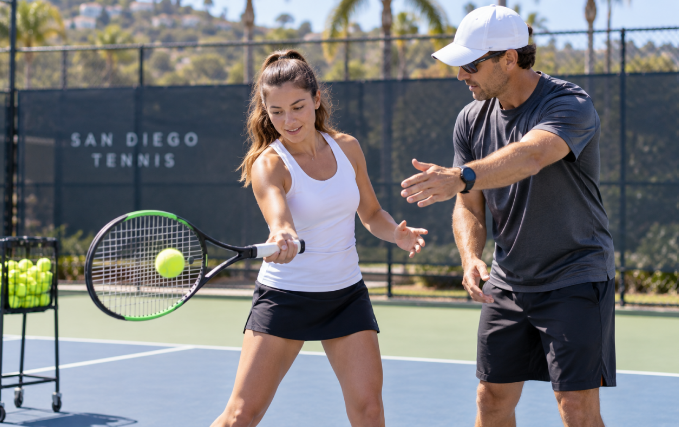
Private lessons provide one-on-one attention. A coach can spend more time identifying specific issues with your technique and adjusting instruction to your pace.
They may be especially useful if you want individualized instruction, have a particular skill you want to improve, or prefer learning outside a group environment.
Some beginners combine the two: group classes for regular play and private lessons for more focused development.
Don't Worry About Hitting Hard
One of the most common beginner mistakes is trying to generate as much power as possible.
Control comes first.
A slow ball that repeatedly lands inside the court is far more useful during the learning process than a hard shot that flies beyond the baseline.
Focus initially on contact, balance, direction, and consistency. Speed can develop as your technique becomes more comfortable.
Research supports the importance of developing the broader physical qualities involved in tennis. A systematic review and meta-analysis of 24 studies found that athletic training among youth and adult tennis players improved agility, balance, endurance, flexibility, strength, and lower-body power.
In other words, becoming a better tennis player isn't simply about learning how to swing a racket harder.
Beginner Tennis Tips for Kids
Parents often wonder how quickly their child should progress.
There's no single timeline.
Some kids quickly become comfortable making contact with the ball, while others need more time to develop coordination and confidence. Both are normal.
For younger players, enjoyment and consistency matter most. A good beginner environment keeps children moving, gives them plenty of opportunities to hit the ball, and introduces skills in manageable steps.
Parents can help by focusing on effort rather than results. Instead of asking, "Did you win?" try asking what they learned, what they enjoyed, or which shot they practiced.
Beginner Tennis Tips for Adults
Adults sometimes make learning harder by expecting themselves to understand everything immediately.
Give yourself permission to be a beginner.
You will miss balls. You'll occasionally forget the score. Some serves won't clear the net, and others may go much farther than intended.
That's part of learning.
Focus on one or two coaching cues at a time rather than correcting your grip, feet, swing, contact point, and follow-through at once.
Regular practice also helps. Even short, consistent sessions can help the movements feel more natural.
Warm Up Before You Play
Tennis involves repeated acceleration, stopping, rotation, and changes of direction, so arrive early enough to prepare your body.
A warm-up might include light movement followed by dynamic exercises and easy hitting.
A 2026 longitudinal study following 317 adult recreational tennis players examined a structured tennis warm-up and cool-down program. High compliance was associated with a significant reduction in injury frequency and overuse injuries at the 12-month assessment, although differences weren't found at every stage.
Beginners don't need an elaborate routine, but developing good preparation habits early is worthwhile.
How Often Should a Beginner Take Tennis Lessons?
No single schedule works for everyone.
For many beginners, consistency matters more than squeezing in as much tennis as possible. Regular lessons give you a chance to reinforce what you've learned before too much time passes.
Your ideal schedule will depend on your age, goals, availability, and whether you're also practicing outside lessons.
Children who love the sport may eventually want additional classes or camps. Adults may prefer a weekly class supplemented by casual practice or private instruction.
The important thing is to choose a routine you can maintain.
Learning Tennis in San Diego County
Having access to instruction close to home can make regular participation much easier.
On The Rise Tennis Academy serves players and families across San Diego County, including Rancho Bernardo, 4S Ranch, Poway, Del Sur, Carmel Mountain Ranch, Saber Springs, Rancho Peñasquitos, Rancho Santa Fe, Carmel Valley, Escondido, Carlsbad, San Marcos, Encinitas, Vista, Mira Mesa, Scripps Ranch, Mission Valley, North Park, Chula Vista, Eastlake, and surrounding communities.
Beginners can choose from kids' classes, adult classes, private tennis lessons, and seasonal summer camps depending on their age, goals, and preferred learning environment.
Ready for Your First Tennis Lesson?
You don't need to understand every rule, own expensive equipment, or know how to serve before you begin. Your first lesson is exactly where you're supposed to learn those things.
Start with comfortable athletic clothing, an appropriate racket, water, and a willingness to practice. From there, focus on developing consistent contact, basic movement, and confidence one step at a time.
Whether you're a parent looking for tennis classes for your child or an adult finally deciding to learn the game, On The Rise Tennis Academy offers beginner-friendly options throughout San Diego County.
Explore kids' group classes, adult tennis lessons, private instruction, and seasonal summer camps at On The Rise Tennis Academy and find the right place to start.
