How to Choose the Right Tennis Program for Your Child in San Diego
How to Choose the Right Tennis Program for Your Child in San Diego
Finding the right tennis program for your child can feel surprisingly complicated. A quick search for tennis lessons in San Diego brings up private coaching, group classes, competitive programs, beginner lessons, seasonal camps, and programs designed for different age groups. How do you know which one is actually right for your child?
The best choice is not necessarily the program with the most intense training schedule. It is the one that matches your child's age, current ability, personality, goals, and level of interest.
At On The Rise Tennis Academy, families throughout San Diego County can choose from kids group classes, private tennis lessons, adult programs, and seasonal summer camps. Understanding the differences between these options can help you choose an environment where your child can learn, improve, and enjoy spending time on the court.
Start With Your Child, Not the Program
Before comparing tennis programs, think about what your child needs right now.
A four-year-old picking up a racket for the first time has very different needs from a 12-year-old who already knows how to serve and rally. Similarly, a child who loves meeting new friends may respond differently to group instruction than a child who prefers focused, individual attention.
Ask yourself a few simple questions:
●Has my child played tennis before?
●Are they interested in tennis casually or eager to improve quickly?
●Do they enjoy learning alongside other children?
●Would they benefit from individual attention?
●How much structured activity fits comfortably into our family's schedule?
●Most importantly, are they having fun?
That final question matters more than parents sometimes realize.
A study of 327 youth sport participants found that enjoyment was associated with whether young athletes continued participating over the following year. The researchers concluded that enjoyment can be an important indicator of future participation or dropout.
For younger and beginner players especially, building positive experiences with tennis can be just as important as learning technically correct strokes.
Look for Age-Appropriate Tennis Instruction
Children should not simply receive a scaled-down version of an adult tennis lesson.
Young players are still developing coordination, attention, confidence, and basic movement skills. Instruction should reflect their developmental stage.
Research involving children ages 6 to 12 compared different approaches to tennis instruction and found improvements in executive functions after both game-based and technique-based tennis sessions.
Another study involving young tennis players found that visual and physical cues incorporated into instruction helped children improve aspects of their forehand technique and performance over a 16-week period.
For parents comparing beginner tennis lessons in San Diego, this highlights an important point: good instruction for children should make learning understandable and manageable.
You want your child to gradually develop fundamentals such as movement, balance, racket control, hand-eye coordination, serving, rallying, and court awareness without feeling overwhelmed.
Group Tennis Classes or Private Lessons?
One of the biggest decisions parents face is choosing between group and private instruction.
Neither option is automatically better. They serve different purposes.
Kids Group Tennis Classes
Group classes can be an excellent starting point for many children.
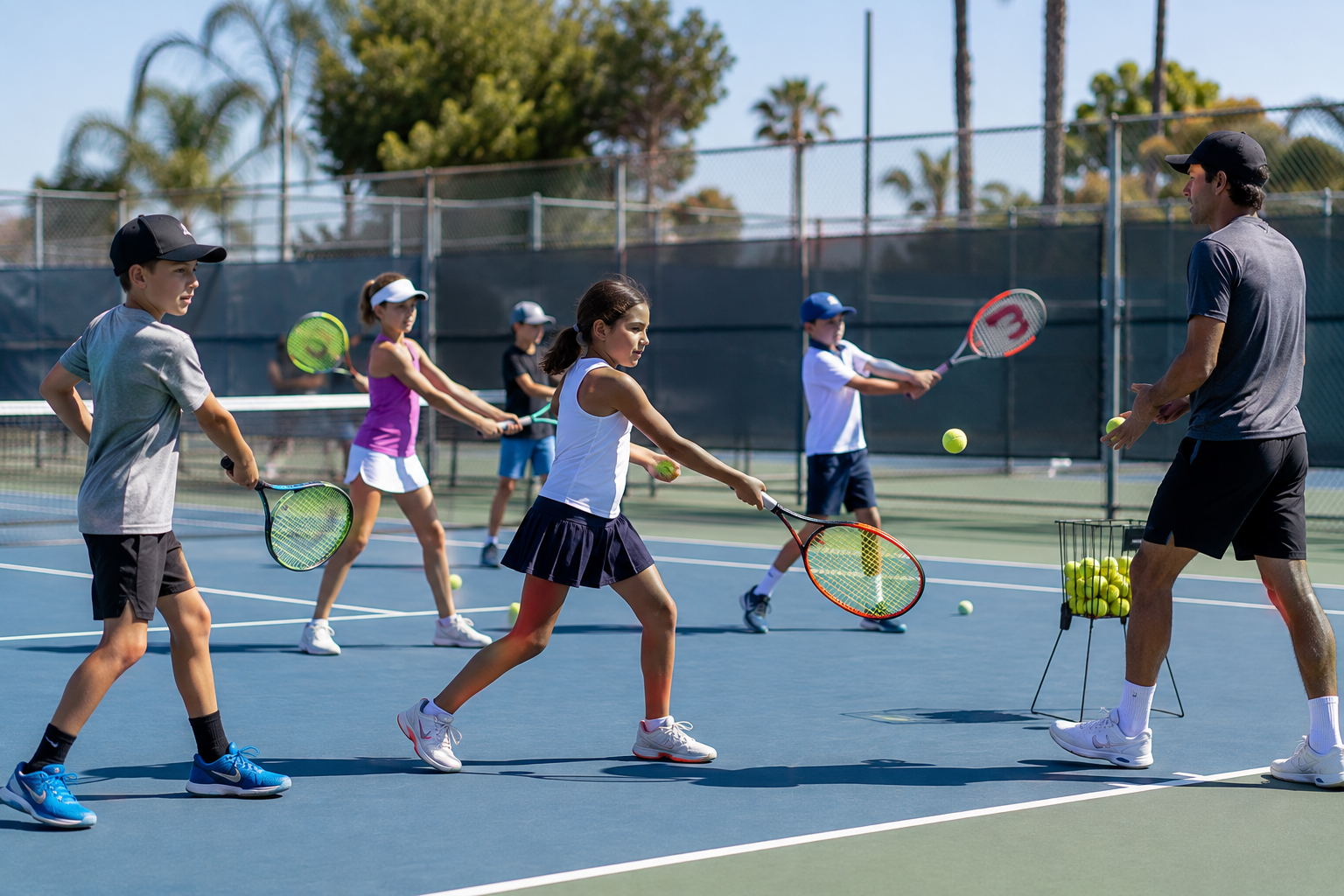
Your child learns alongside other players, participates in drills and games, and experiences the social side of tennis. For beginners, a group setting can make learning feel less intimidating and more like an activity they look forward to each week.
Group tennis classes for beginners may be particularly appropriate when your child's primary goals are to:
●Learn the fundamentals
●Become comfortable on a tennis court
●Meet and play with other children
●Develop coordination and movement
●Build confidence
●Discover whether they enjoy tennis
The social environment matters, too. Research involving adolescent athletes found that positive social climates and strong coach relationships were associated with greater enjoyment and intention to continue participating in sport.
Group lessons can therefore offer something beyond technical instruction: a community where children associate tennis with learning, friendships, and fun.
Private Tennis Lessons
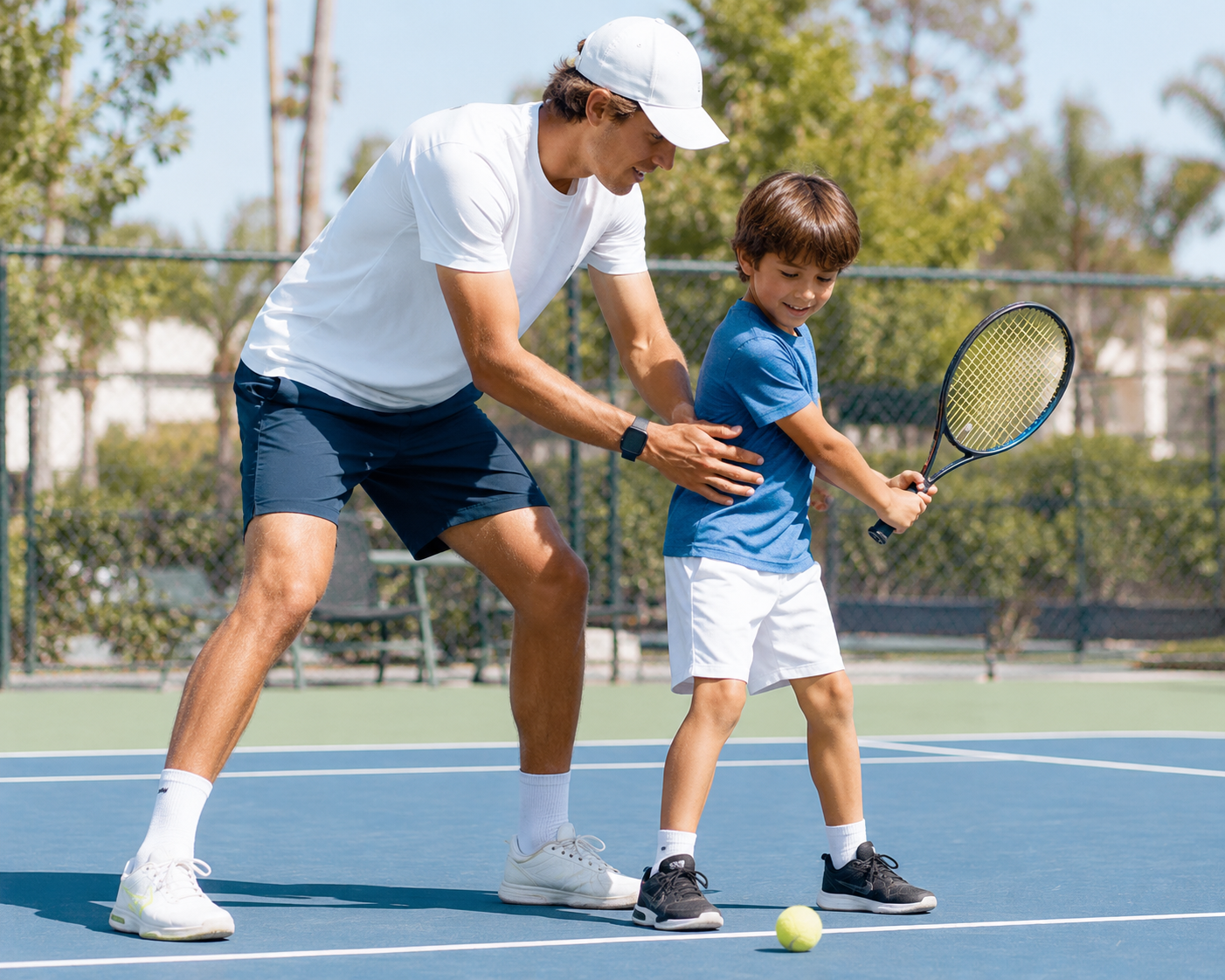
Private lessons provide more individualized attention.
Because the coach is working with one player, the session can focus more closely on that child's technique, habits, strengths, and areas that need improvement.
Private tennis lessons in San Diego can make sense for children who:
●Learn better one-on-one
●Want additional help with a particular skill
●Already play tennis and want to progress further
●Need focused work on serving, footwork, strokes, or strategy
●Prefer individual instruction
●Want extra preparation alongside their regular group training
Parents do not necessarily have to choose exclusively between private and group lessons. Depending on your child's goals and schedule, the two formats can complement each other.
Group classes provide regular practice and interaction with other players, while occasional private instruction can address specific areas more closely.
Pay Attention to the Coaching Environment
When evaluating a tennis academy in San Diego, look beyond the courts and class schedule. The coach your child interacts with can strongly influence how they feel about the sport.
A good youth tennis coach should be able to correct mistakes without making children afraid of making them. Kids need instruction, but they also need opportunities to experiment, ask questions, and gradually build confidence.
A large prospective study involving 7,110 adolescent athletes across several sports found that intrinsic motivation, feelings of competence, autonomy, relatedness, and an empowering coach-created environment were associated with continuing in sport the following season. A more disempowering environment was associated with dropout.
When observing a class or talking with an academy, consider how coaches communicate.
Does the coach explain things in a way children understand? Do they recognize effort as well as results? Are children actively involved rather than waiting around for long periods? Does the environment feel encouraging while still providing meaningful instruction?
Those details can tell you a lot about whether your child will enjoy returning week after week.
Match the Program to Your Child's Current Skill Level
Putting a child in a program that is too advanced can leave them frustrated. A program that is far below their ability may leave them bored.
Look for instruction that meets your child where they are.
For complete beginners, early lessons should establish basic skills and familiarity with the game. As children improve, instruction can gradually introduce more challenging rallies, movement patterns, serves, point play, and strategy.
Progress does not need to happen at the same speed for every child.
Some children become comfortable hitting the ball quickly but need more time with footwork. Others understand technique but need experience playing points against different opponents.
A strong tennis program should recognize those differences rather than expecting every player of the same age to develop identically.
Consider Your Child's Personality
Skill level is only part of the equation.
Think about how your child naturally learns.
An outgoing child may love the energy of group tennis classes. A quieter child might initially feel more comfortable receiving private instruction. A highly competitive teenager may want more challenging practice, while another child may simply want an active hobby they can enjoy with friends.
No single motivation is "correct" for playing tennis.
Your goal should be to find an environment that encourages your child to keep developing without turning every lesson into a test.
This matters especially when children begin showing potential. More training is not always automatically better.
A systematic review and meta-analysis of 1,429 adolescent athletes found higher levels of several aspects of burnout among athletes specializing in one sport than those participating more broadly.
For parents, the practical takeaway is simple: development should be sustainable. Children need opportunities to learn and improve, but they also need balance.
Think About Location and Your Weekly Routine
Even a great program can become difficult if attending it creates constant stress for your family.
San Diego County is large, so location and scheduling deserve serious consideration.
Families in Rancho Bernardo, 4S Ranch, Poway, Del Sur, Carmel Mountain Ranch, Saber Springs, Rancho Peñasquitos, Rancho Santa Fe, Carmel Valley, Escondido, Carlsbad, San Marcos, Encinitas, Vista, Mira Mesa, Scripps Ranch, Mission Valley, North Park, Chula Vista, Eastlake, and surrounding communities may have very different weekly travel requirements.
Before committing to a program, think realistically about school schedules, homework, other sports and activities, transportation, and family commitments.
Consistency is valuable. A program your child can attend comfortably and regularly may be a better long-term choice than one that makes every week difficult to manage.
Don't Overlook Summer Tennis Camps
If your child is curious about tennis but you aren't ready to commit to an ongoing schedule, a summer tennis camp in San Diego can offer another way to experience the sport.
Camps can also help existing players who want more court time during school breaks.
The more concentrated format gives children opportunities to practice skills repeatedly, interact with other players, and become more familiar with tennis over a relatively short period.
When comparing summer camps, use many of the same criteria you would for regular lessons. Consider the child's age, ability, coaching environment, daily schedule, and whether activities appear appropriately challenging.
A summer camp should still feel like something your child is excited to attend.
Watch for Signs You've Found the Right Program
You do not need to judge a tennis program entirely by how many balls your child gets over the net during the first lesson.
Instead, look for progress over time.
Your child may begin talking about what they learned. They might ask to practice at home, get excited about their next lesson, or start remembering corrections without prompting.
Physical and technical improvement matters, but so do confidence, independence, and enthusiasm.
If your child regularly leaves the court feeling discouraged, anxious, or uninterested, it may be worth asking why. Sometimes they simply need time to adjust. In other cases, a different class level, coaching format, or program may be a better fit.
Questions to Ask Before Choosing a Tennis Program
Before registering, ask questions that help you understand what your child's experience will actually look like:
1.Is this class appropriate for my child's age and current experience?
2.How is instruction adapted for beginners?
3.What skills will children work on?
4.Would group or private lessons be better for my child's goals?
5.How does the program help children progress?
6.What should my child bring to class?
7.Are summer camps available?
8.What options are available if my child wants additional instruction?
A tennis academy should help you understand your options rather than expecting you to know exactly which program to choose.
Help Your Child Find the Right Tennis Program in San Diego
Choosing a tennis program is ultimately about finding the right fit for your child today while giving them room to grow tomorrow.
Consider their age, ability, personality, goals, schedule, and enjoyment. Look for instruction that balances skill development with an encouraging environment, and remember that the "best" program is the one your child can learn from and genuinely wants to return to.
On The Rise Tennis Academy offers kids group classes, private tennis lessons, adult group classes, and seasonal summer camps for players across San Diego County.
Whether your child is holding a racket for the first time or looking for opportunities to continue developing their game, explore the available programs and find an option that fits your family.
Visi tOn The Rise Tennis Academy to learn more and register for tennis classes, private lessons, or summer camps.
